

Introduction
Language is constantly evolving. New words emerge, old expressions take on fresh meanings, and sometimes a term appears online that sparks widespread curiosity. Jememôtre is one such word.

If you have recently come across the term, you may have noticed that there is no single, universally accepted definition. That uncertainty is exactly what has attracted attention. Across blogs, creative communities, and discussions focused on personal development, jememôtre is often described as a concept connected to self-awareness, identity, reflection, and authentic self-expression.
Unlike traditional words that have fixed definitions in dictionaries, jememôtre exists in a more flexible space. People use it to describe the process of looking inward, understanding themselves more deeply, and presenting their true identity to the world.
This guide explores what jememôtre means, where it may have originated, why it resonates with modern audiences, and how its ideas can be applied in everyday life.
| Label | Information |
|---|---|
| Name | Jememôtre |
| Type | Modern concept |
| Main Focus | Self-awareness |
| Purpose | Personal reflection |
| Category | Personal development |
| Core Idea | Understanding yourself |
| Related Topics | Identity and growth |
| Common Use | Self-discovery discussions |
| Key Feature | Authentic living |
| Popularity | Growing online interest |
| Typical Audience | Curious readers and learners |
| Practical Value | Encourages mindful thinking |
| Overall Meaning | A journey toward self-understanding |
What Is Jememôtre?
At its core, jememôtre refers to a personal process of self-reflection and self-understanding. It is often associated with the idea of measuring personal growth according to one’s own values rather than according to society’s expectations.
Many interpretations describe it as a blend of self-observation and self-expression. Instead of focusing on how others judge us, jememôtre encourages individuals to understand who they truly are and what genuinely matters to them.
The concept is particularly appealing in today’s world, where people are constantly exposed to social comparisons, public opinions, and digital validation. Jememôtre offers a different perspective. It suggests that meaningful growth begins internally.
Rather than asking, “How do others see me?” the concept encourages a more personal question: “How do I understand myself?”
The Meaning Behind the Word
One reason jememôtre has generated so much interest is its unusual structure. Many writers believe it draws inspiration from French linguistic elements.
Some interpretations connect it to phrases that suggest “I show myself,” while others associate it with ideas related to “measuring oneself” or understanding one’s inner state. Because the term is relatively new and not officially standardized, there is no universally accepted explanation.
What makes the word fascinating is that its ambiguity allows different people to connect with it in different ways.
For some, jememôtre represents self-discovery.
For others, it symbolizes emotional awareness.
Some see it as a reminder to remain authentic in a world filled with external pressures.
This flexibility is part of its growing appeal.
Why Jememôtre Matters Today
Modern life is filled with measurements.
People measure success through income, social media followers, achievements, grades, promotions, and countless other indicators. While these measurements can be useful, they do not always capture personal fulfillment or emotional well-being.
This is where the concept of jememôtre becomes relevant.
It shifts attention away from external metrics and toward internal understanding. Instead of comparing yourself to others, the focus becomes understanding your own journey.
Many individuals feel overwhelmed by constant comparison. Social platforms often encourage people to present idealized versions of themselves. As a result, many struggle to separate genuine identity from public image.
Jememôtre offers an alternative approach. It emphasizes self-awareness rather than performance.
This message resonates strongly with people seeking greater balance, authenticity, and emotional clarity.
The Connection to Self-Reflection
One of the strongest themes associated with jememôtre is self-reflection.
Self-reflection involves examining thoughts, emotions, actions, and experiences in an honest and meaningful way. It allows individuals to learn from the past while making better decisions for the future.
When people practice self-reflection, they become more aware of patterns in their lives. They begin to understand what motivates them, what challenges them, and what brings them fulfillment.
Jememôtre can be viewed as a framework for this process.
Rather than judging yourself harshly, the concept encourages observation and understanding. The goal is not perfection. The goal is awareness.
Through reflection, people often discover insights that help them grow emotionally, professionally, and personally.
Identity and Personal Growth
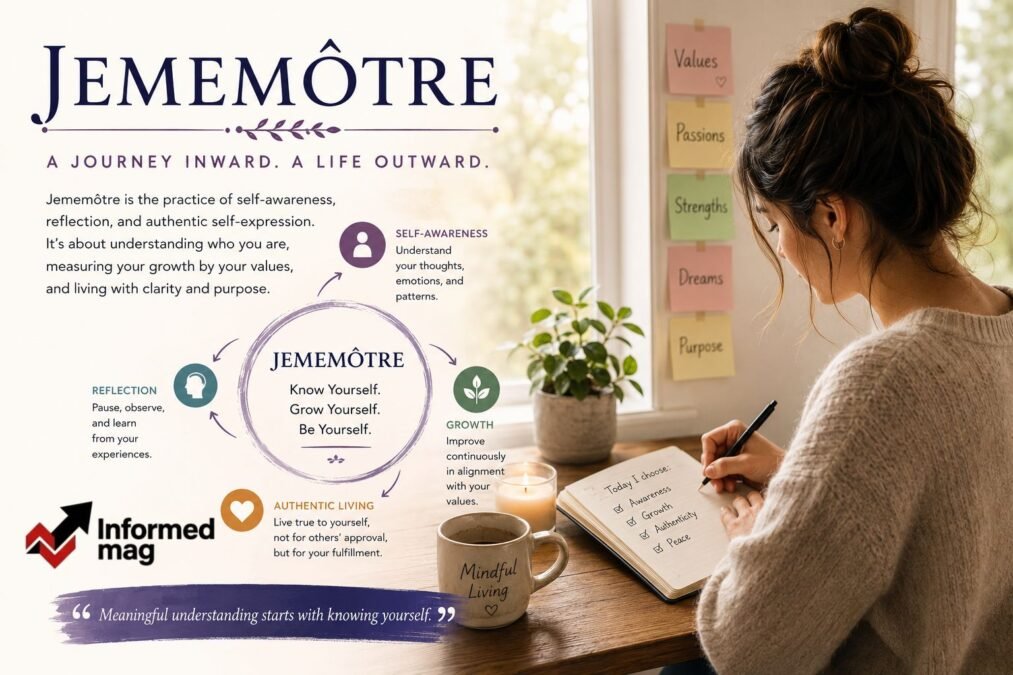
Identity is another major theme linked to jememôtre.
Every person develops a sense of self over time. Experiences, relationships, beliefs, and personal choices all contribute to identity formation.
However, identity is rarely fixed.
People evolve throughout their lives. They gain new perspectives, overcome challenges, and redefine their priorities. Jememôtre acknowledges this ongoing evolution.
Instead of viewing identity as a static label, the concept encourages individuals to see it as a continuous journey.
This perspective can be empowering.
It reminds people that growth is possible. It suggests that personal development does not end at a certain age or stage of life. Instead, it continues through learning, reflection, and experience.
By embracing self-awareness, individuals become more intentional about the people they are becoming.
Jememôtre and Authentic Living
Authenticity has become an increasingly important topic in modern culture.
People often feel pressure to meet expectations established by family, society, workplaces, or online communities. While external expectations can influence behavior, they do not always align with personal values.
Jememôtre encourages a more authentic approach to life.
Authentic living means making choices that reflect genuine beliefs and priorities. It involves understanding who you are rather than simply following trends or seeking approval.
This does not mean ignoring other people. Instead, it means maintaining a clear understanding of your own values while interacting with the world around you.
Many people who explore concepts similar to jememôtre describe a greater sense of confidence, clarity, and personal fulfillment.
Authenticity creates consistency between inner beliefs and outward actions.
That consistency often leads to stronger relationships and greater emotional well-being.
How Jememôtre Appears in Digital Culture
The rise of digital communication has played an important role in the popularity of terms like jememôtre.
Online spaces allow ideas to spread quickly across cultures and communities. New concepts can gain attention even without formal academic recognition.
In digital culture, jememôtre is often associated with content related to:
- Personal growth
- Mindfulness
- Journaling
- Creative writing
- Identity exploration
- Emotional awareness
- Authentic self-expression
Writers, artists, and content creators frequently explore themes that align with the concept.
Many people are searching for language that captures complex emotional experiences. Jememôtre appears to fill that need by providing a symbolic way to discuss self-awareness and personal identity.
Its growing presence online reflects broader cultural interest in mental well-being and self-understanding.
Creative Interpretations of Jememôtre
One reason the concept remains interesting is its openness to interpretation.
Artists often use symbols and abstract ideas to communicate emotions that are difficult to express directly. Jememôtre functions in a similar way.
In creative spaces, it may represent:
- Personal transformation
- Emotional honesty
- Identity exploration
- Self-expression
- Memory and reflection
Writers may use the term to describe a journey of self-discovery.
Artists may connect it to themes of identity and personal truth.
Creative communities often embrace words that encourage interpretation rather than strict definition.
This flexibility helps explain why the concept continues to generate discussion.
Common Misunderstandings
Because jememôtre lacks a standardized definition, misunderstandings are common.
One misconception is that it belongs to a formal academic discipline. While it draws upon ideas related to psychology, philosophy, and personal development, it is not currently recognized as an established academic term.
Another misunderstanding is that it has a single official meaning.
In reality, different writers interpret it differently. Some emphasize self-measurement. Others focus on self-expression or self-awareness.
A third misconception is that the term originated from a specific movement or organization.
Available discussions suggest that its meaning has developed organically through online use rather than through a single authoritative source.
Understanding these distinctions helps readers approach the concept with realistic expectations.
Applying Jememôtre in Everyday Life
Although the concept may seem abstract, its principles can be applied practically.
One approach is regular self-reflection.
Taking a few minutes each day to examine thoughts, feelings, and experiences can improve self-awareness over time.
Journaling is another effective practice.
Writing about daily experiences often reveals patterns that would otherwise remain unnoticed. It helps people clarify their goals and understand their emotions.
Mindful observation can also support the ideas associated with jememôtre.
Instead of reacting automatically to every situation, individuals can pause and consider their thoughts and responses.
Personal goal setting offers another practical application.
Rather than defining success solely through external achievements, people can establish goals that align with their values and priorities.
These simple practices encourage a deeper understanding of oneself.
The Growing Appeal of Jememôtre
The popularity of jememôtre reflects broader cultural changes.
People are increasingly interested in mental wellness, emotional intelligence, and personal growth. They are looking for concepts that help them understand themselves in meaningful ways.
Traditional measures of success no longer satisfy everyone. Many individuals want a deeper sense of purpose and fulfillment.
Jememôtre speaks to that desire.
Its emphasis on reflection, authenticity, and self-awareness aligns with contemporary conversations about well-being and identity.
As digital culture continues to evolve, concepts like jememôtre may become even more relevant.
Frequently Asked Questions
What does jememôtre mean?
Jememôtre is generally understood as a concept related to self-awareness, personal reflection, and understanding one’s true identity. Its meaning can vary depending on the context in which it is used.
Is jememôtre an official dictionary word?
No, jememôtre is not widely recognized in major dictionaries. It is mostly discussed online as a modern idea connected to personal growth, authenticity, and self-discovery.
Why has jememôtre become popular?
The term has gained attention because many people are interested in topics such as mindfulness, emotional well-being, and personal development. Jememôtre reflects these growing interests.
How can I apply the idea of jememôtre in daily life?
You can practice the principles associated with jememôtre through self-reflection, journaling, mindful thinking, and making decisions that align with your personal values and goals.
Does jememôtre have only one meaning?
No. Since the term is relatively new and open to interpretation, different people may view it differently. Common themes include self-understanding, authenticity, and personal transformation.
Conclusion
Jememôtre is best understood as a modern concept centered on self-awareness, reflection, identity, and authentic living. While it does not have an official dictionary definition, its growing popularity demonstrates a widespread interest in understanding the self more deeply.
In a world that often emphasizes external achievements and public validation, jememôtre offers a reminder that personal growth begins within.
Whether viewed as a philosophy, a symbolic expression, or a framework for self-reflection, the concept encourages individuals to examine their thoughts, values, and experiences with honesty and curiosity.
Ultimately, the lasting appeal of jememôtre lies in its message: meaningful understanding starts with knowing yourself.
